
The average content team publishes 15 pieces per month. Teams using AI for content creation publish 64 — without adding headcount, according to a 2025 Content Marketing Institute survey. That's not a marginal improvement. That's a fundamentally different operating model.
But here's the uncomfortable truth: most people using AI for content creation are doing it wrong. They're pasting a topic into ChatGPT, copying the output into WordPress, and wondering why it reads like a robot wrote a term paper. The result? Generic content that ranks nowhere, converts nobody, and slowly erodes brand credibility.
AI content creation works when you treat AI as a production system, not a magic button. This guide walks through the complete workflow — from ideation to publishing — for blog posts, social media, video scripts, newsletters, and SEO content. No theory. No hype. Just the process that actually produces results.
Key Takeaways
- AI content creation is a workflow, not a prompt — the best results come from structured processes across ideation, drafting, editing, and distribution
- Different content types need different approaches — blog posts, social media, video scripts, and newsletters each have distinct AI workflows
- Use multiple AI capabilities together: web search for research, language models for drafting, image generation for visuals, and code tools for data analysis
- Human editing is non-negotiable — AI generates the 80% draft, you add the 20% that makes it worth reading
- You don't need five subscriptions — platforms like ZeroTwo bundle chat, image generation, web search, code execution, and document analysis so your entire content workflow lives in one place
- AI saves 60-70% of production time when implemented correctly, but only if you build repeatable systems
What Is AI Content Creation?
AI content creation is the process of using artificial intelligence tools — large language models, image generators, web research assistants, and automation platforms — to plan, draft, edit, and distribute content across formats. It covers everything from writing a blog post to generating social media graphics to scripting a YouTube video.
Here's what falls under the AI content creation umbrella:
| Content Type | AI Application | Typical Output |
|---|---|---|
| Blog Posts | Research, outlining, drafting, SEO optimization | 2,000-word article drafted in 30 minutes |
| Social Media | Platform-specific copy, hashtag research, image generation | 20 LinkedIn posts from one blog post |
| Video Scripts | Scriptwriting, hook generation, B-roll suggestions | 10-minute YouTube script with timestamps |
| Newsletters | Curation, summarization, personalization | Weekly newsletter assembled in 15 minutes |
| SEO Content | Keyword research, content briefs, SERP analysis | Data-driven content calendar for 90 days |
| Ad Copy | Headline variants, body copy, CTA testing | 30 ad variations for A/B testing |
The critical distinction: AI handles the production and research layers. You still own the strategy, voice, and editorial judgment layers.
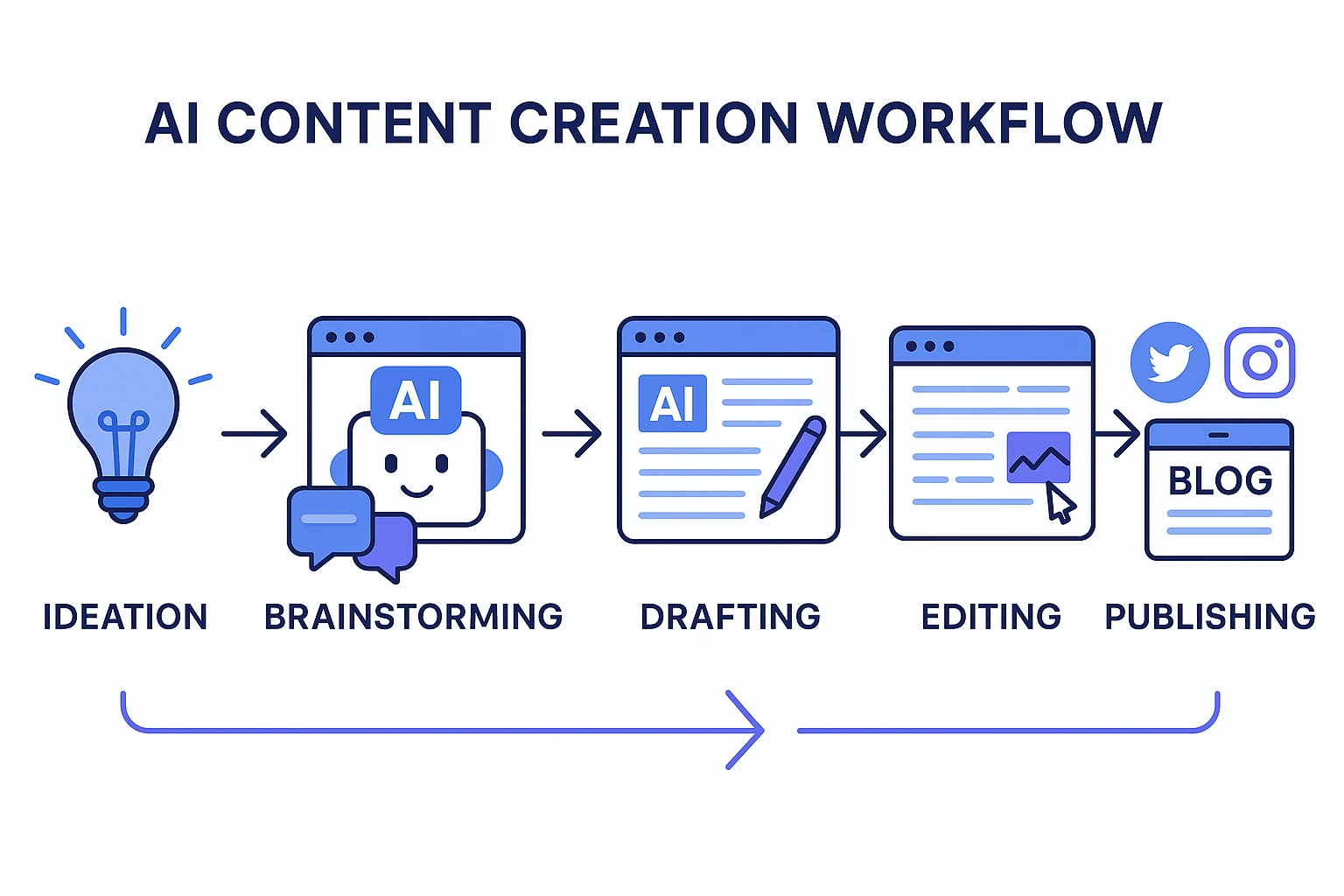
The Complete AI Content Creation Workflow
Every piece of content — regardless of format — follows the same five-stage workflow. Master this system and you can apply it to any content type.
Stage 1: Research and Ideation
This is where most content creators skip straight to drafting and immediately produce something mediocre. Research is the highest-leverage stage in the entire workflow.
What to do with AI at this stage:
- SERP analysis — Use AI with web search to analyze the top 10 results for your target keyword. What angles are covered? What's missing?
- Audience research — Ask AI to identify the specific questions your audience is asking on Reddit, Quora, and forums
- Competitive gap analysis — Feed competitor content into AI and ask it to identify angles they've missed
- Data gathering — Use web search to find relevant statistics, studies, and expert quotes to support your content
Research prompt framework:
Research the topic "[your keyword]" for a [content type]. Analyze:
1. Top-ranking content - what angles do they cover?
2. Common questions people ask about this topic
3. Gaps in existing content that I could fill
4. Recent statistics or studies (last 12 months)
5. Expert perspectives worth referencing

Target audience: [describe your reader]
Goal: Find a unique angle that existing content misses
This stage takes 15-20 minutes with AI. Without AI, it takes 2-3 hours.
Stage 2: Structure and Outline
An outline is the skeleton that determines whether your content stands up or collapses. AI excels here because it can generate multiple structural approaches and let you pick the strongest one.
The three-outline method:
Ask AI to generate three different outlines for the same topic:
- Problem-solution structure — Start with the pain, end with the fix
- Sequential structure — Step-by-step walkthrough
- Comparison structure — Options, tradeoffs, recommendations
Pick the one that best fits your angle, then refine it. This prevents the most common AI content mistake: defaulting to the same predictable listicle structure every time.
For SEO content specifically:
- Include your primary keyword in the H1 and at least two H2s
- Structure H2s as questions or "how to" phrases for featured snippet capture
- Plan for a definition paragraph early in the piece (targets position zero)
- Map out internal and external links at the outline stage
Stage 3: Drafting
Here's where the actual writing happens — and where your approach matters most.
The section-by-section method:
Never ask AI to write an entire article in one shot. Instead:
- Draft section by section, providing context for each
- Include specific instructions for tone, depth, and examples
- Reference your research findings in each section prompt
- Request specific data points, not vague claims
Section drafting prompt framework:
Write the section "[H2 heading]" for a blog post about [topic].

Context: This section follows [previous section summary] and should
lead into [next section topic].

Requirements:
- 200-400 words
- Include at least one specific statistic or example
- Tone: conversational but expert — like explaining to a smart colleague
- Use short paragraphs (2-3 sentences max)
- Include a practical tip or actionable takeaway
Common drafting mistakes to avoid:
- Asking for "a blog post about X" with no structure or context
- Using the same model and prompt for every content type
- Not providing brand voice guidelines or examples
- Accepting the first draft without iteration
Stage 4: Editing and Refinement
This is the stage that separates AI-assisted content from AI-generated slop. Every piece needs human editing — period.
The two-model editing technique:
Use a different AI model for editing than you used for drafting. Claude catches different issues than GPT-4, and Gemini spots different patterns than both. Running your draft through a second model for critique produces measurably better output.
Editing checklist for AI-generated content:
- Remove generic filler phrases ("In today's fast-paced world...")
- Replace vague claims with specific data points
- Add personal experience or original perspective
- Check that every section delivers on what the headline promises
- Ensure transitions between sections feel natural
- Verify all statistics and links
- Read the opening paragraph — would you keep reading?
- Cut anything that doesn't serve the reader
Pro tip: Instead of juggling separate subscriptions for drafting, editing, and research, use an all-in-one platform like ZeroTwo to access multiple frontier models — GPT-4, Claude, Gemini — from a single interface. Draft with one model, edit with another, and research with web search, all without switching tabs.
Stage 5: Visuals and Publishing
AI-generated content needs visuals. Blog posts with images get 94% more views than those without, according to MDG Advertising research.
Visual content you can create with AI:
- Hero images for blog posts and newsletters
- Social media graphics sized for each platform
- Infographics from data points in your content
- Diagrams and flowcharts for process explanations
- Thumbnail images for video content
Publishing optimization:
- Generate meta descriptions optimized for click-through rate
- Create 5-10 social post variations to promote each piece
- Build an email teaser for newsletter distribution
- Repurpose the core content into platform-specific formats
AI Content Creation by Format
Blog Posts and SEO Content
Blog posts are the foundation of most content strategies, and they're where AI delivers the most measurable time savings.
Time comparison:
| Stage | Without AI | With AI | Time Saved |
|---|---|---|---|
| Research | 2-3 hours | 20 minutes | ~85% |
| Outline | 30-60 minutes | 10 minutes | ~80% |
| Drafting | 3-4 hours | 45 minutes | ~80% |
| Editing | 1-2 hours | 45 minutes | ~50% |
| Visuals | 1-2 hours | 20 minutes | ~75% |
| Total | 8-12 hours | 2.5 hours | ~70% |
SEO-specific AI tactics:
- Keyword clustering — Feed a list of related keywords into AI and ask it to group them by search intent (informational, transactional, navigational)
- Content brief generation — Provide your target keyword and let AI analyze the SERP to build a comprehensive brief
- Internal linking suggestions — Upload your sitemap or list of existing content and ask AI to identify linking opportunities
- Schema markup generation — Ask AI to write FAQ or HowTo schema for your content
Social Media Content
Social media is where AI content creation pays off fastest because the volume requirements are relentless.
The content multiplication framework:
Take one long-form piece (blog post, podcast, video) and use AI to generate:
- 5-10 LinkedIn posts — each highlighting a different insight
- 10-15 Twitter/X posts — key quotes, statistics, and hot takes
- 3-5 Instagram captions — visual-first, story-driven
- 2-3 TikTok/Reels hooks — attention-grabbing opening lines
- 1 thread — sequential breakdown of the full piece
Platform-specific prompt tips:
- For LinkedIn: Ask for professional tone with a personal angle, include a hook in the first line
- For Twitter/X: Request punchy, opinionated takes under 280 characters
- For Instagram: Focus on storytelling and emotional hooks with line breaks for readability
Video Scripts
AI is surprisingly effective at video scripting because scripts follow rigid structural patterns that language models handle well.
Video script structure AI excels at:
- Hook (first 5 seconds) — Generate 10 hook options and pick the most provocative
- Setup (30-60 seconds) — Context and why the viewer should care
- Body (main content) — Key points with transition language
- CTA (final 15-30 seconds) — Subscribe, comment, or link prompt
Script prompt framework:
Write a YouTube script for a [length] video about [topic].

Structure:
- Hook: Pattern interrupt or surprising claim (first 5 seconds)
- Intro: Why this matters to [audience] (30 seconds)
- Main points: [3-5 key points] with examples
- Transitions: Smooth bridges between sections
- CTA: [desired action]

Tone: [casual/professional/educational]
Include: B-roll suggestions in [brackets]
Newsletter Content
Newsletters benefit from AI in two ways: curation and original commentary.
AI newsletter workflow:
- Curation — Use web search to find the 5-10 most relevant stories in your niche from the past week
- Summarization — Have AI summarize each story in 2-3 sentences
- Commentary — Write your original take on each story (this is where human perspective matters most)
- Subject lines — Generate 10 options and pick the one with the strongest curiosity gap
- Preview text — Optimize the email preview for mobile open rates
Common AI Content Creation Mistakes
These are the patterns that produce bad content and waste time:
- No editing pass — Publishing AI first drafts is how you lose audience trust
- Same prompt, every time — Different content types need different instructions, context, and model configurations
- Ignoring brand voice — If you don't specify voice guidelines, AI defaults to bland corporate tone
- Skipping research — Drafting without research produces content that says nothing new
- Over-relying on one model — GPT-4, Claude, and Gemini each have strengths; the best workflow uses multiple models for different stages
- No measurement — Track time saved and content performance, or you're flying blind
- Prompt-and-pray — Treating AI as a single-prompt tool instead of building a structured workflow
The AI Content Creation Tool Stack
Here's what most content creators end up paying for when they piece together an AI content workflow:
- ChatGPT Plus — $20/mo (drafting)
- Claude Pro — $20/mo (editing and analysis)
- Perplexity Pro — $20/mo (research)
- Midjourney or DALL-E — $10-20/mo (image generation)
- Total: $70-80/mo before any specialized tools
That's $840-960/year, and you're context-switching between four different platforms for every piece of content you create.
The smarter approach: Use a unified platform that combines multiple AI models and content creation capabilities. ZeroTwo gives you access to frontier models from OpenAI, Anthropic, and Google — plus image generation, web search, code execution, and document analysis — in a single subscription with no per-message limits. For content creators, solopreneurs, and lean teams, the workflow consolidation alone is worth it.
Minimum Viable AI Content Stack
| Layer | What You Need | Why |
|---|---|---|
| Core AI | Multi-model access (GPT-4, Claude, Gemini) | Different models excel at different content stages |
| Research | Web search + document analysis | SERP analysis, competitive research, fact-checking |
| Visual | Image generation | Blog images, social graphics, thumbnails |
| Distribution | Scheduling tool (Buffer, Typefully, etc.) | Publish AI-generated content across platforms |
| Analytics | GA4, Search Console, social analytics | Measure what AI-assisted content actually produces |
Getting Started: Your First AI Content Week
Don't try to automate everything at once. Here's a practical first-week plan:
Day 1-2: Audit your current process. List every content task you do weekly. Note how long each takes. Flag the repetitive, template-based tasks — those are your AI candidates.
Day 3: Pick one content type. For most creators, start with blog posts or social media. These have the clearest workflows and the most measurable time savings.
Day 4-5: Run the full workflow. Use the five-stage process above for one piece of content. Research, outline, draft, edit, publish. Track your time at each stage.
Day 6-7: Repurpose and distribute. Take that one piece and use AI to generate social posts, an email teaser, and a video script outline from the same core content. Measure how long the repurposing takes versus creating each from scratch.
Within two weeks, you'll have concrete data on where AI saves time and where your specific content still needs heavy human input.
The Bottom Line
AI content creation isn't about replacing writers. It's about building a production system that lets you create more — and better — content without burning out or blowing your budget.
The workflow that works: research with AI, structure with AI, draft with AI, edit with humans, publish with data. Every stage has specific tools and techniques that produce better output than just "asking ChatGPT."
Start with one content type. Build the workflow. Measure the results. Then expand to the next format. The content teams winning right now aren't the ones with the fanciest tools — they're the ones who've turned AI content creation into a repeatable system.
Building your AI content workflow? Drop your biggest challenge in the comments — we read every one.