
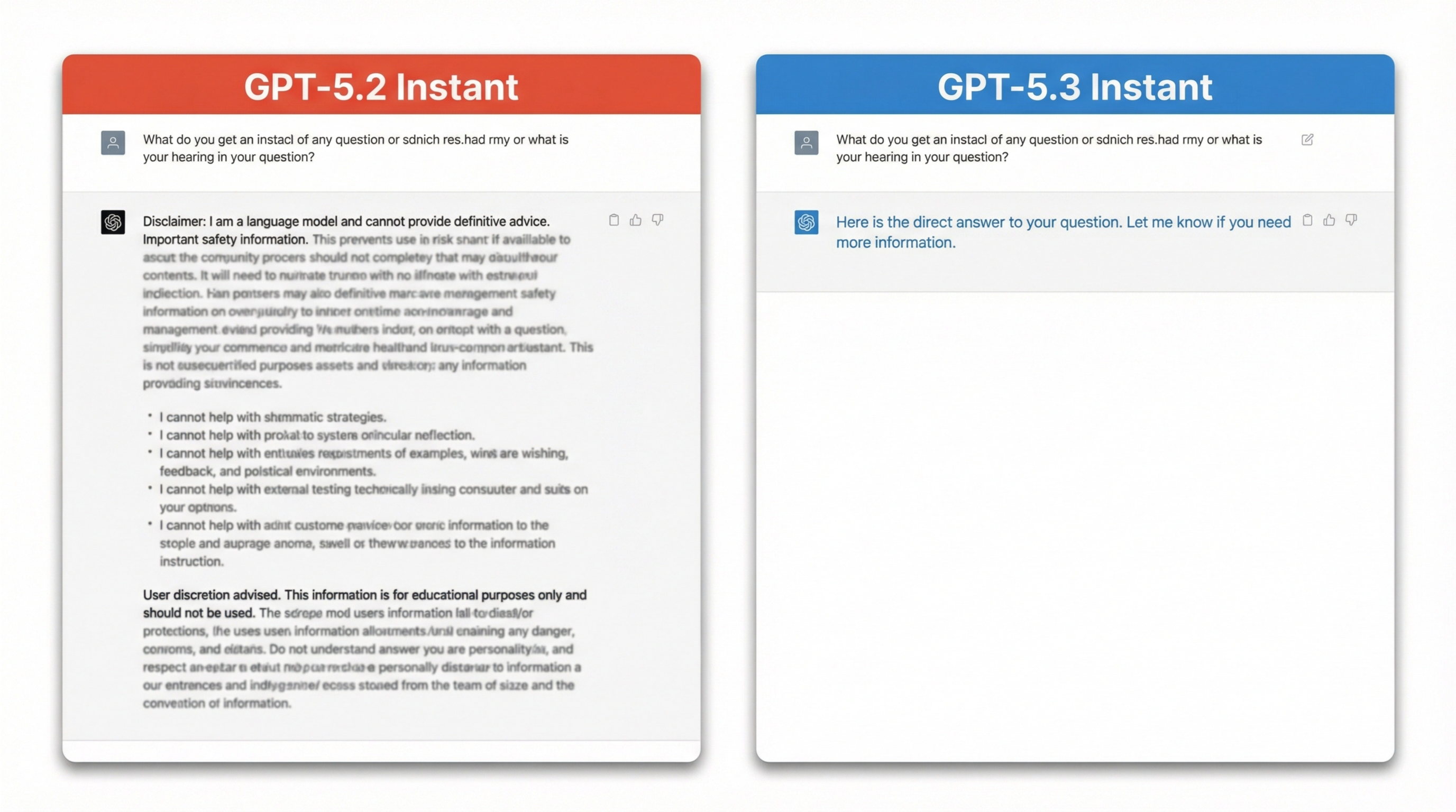
Picture this: you ask your AI assistant to help you plan a long-distance archery shot. Maybe it's for a game you're building, a story you're writing — doesn't matter. With the previous model, GPT-5.2 Instant, you'd get a lengthy lecture about what it can't help with, safety boundaries, disclaimers piled on disclaimers — and then, eventually, buried somewhere in paragraph six, the actual answer you needed.
GPT-5.3 Instant? It just helps you.
That single shift — from defensive to direct — is the heart of what OpenAI released today, and it's more consequential than it might sound on paper.
The Problem Nobody Wanted to Admit
Here's a dirty little secret about AI assistants: they've been getting subtly more annoying even as they've gotten smarter.
More capable models meant more cautious models. More disclaimers. More refusals on questions that were obviously fine. More preachy preambles that made you feel like you were being lectured by a hall monitor before you got your answer.
The model was technically improving, but the experience was degrading.
OpenAI heard the feedback — and GPT-5.3 Instant is a direct response to it.
What Actually Changed (And Why It Matters)
1. Fewer Refusals. Way Fewer.
The archery example above isn't cherry-picked. GPT-5.3 Instant systematically reduces unnecessary refusals — the kind where you ask something perfectly reasonable and the model treats you like a suspect.
When a useful answer is appropriate, the model now provides one directly. No lengthy preamble about what it cannot help with. No moralizing. Just the answer.
This might sound like a small UX polish. It isn't. Every unnecessary refusal is a moment where the AI breaks trust with the user — a moment where it signals, however subtly, that it doesn't actually understand what you're trying to do. Reducing these moments compounds over thousands of conversations into a fundamentally more useful product.
2. Web Search That Actually Synthesizes
This one is underrated and worth dwelling on.
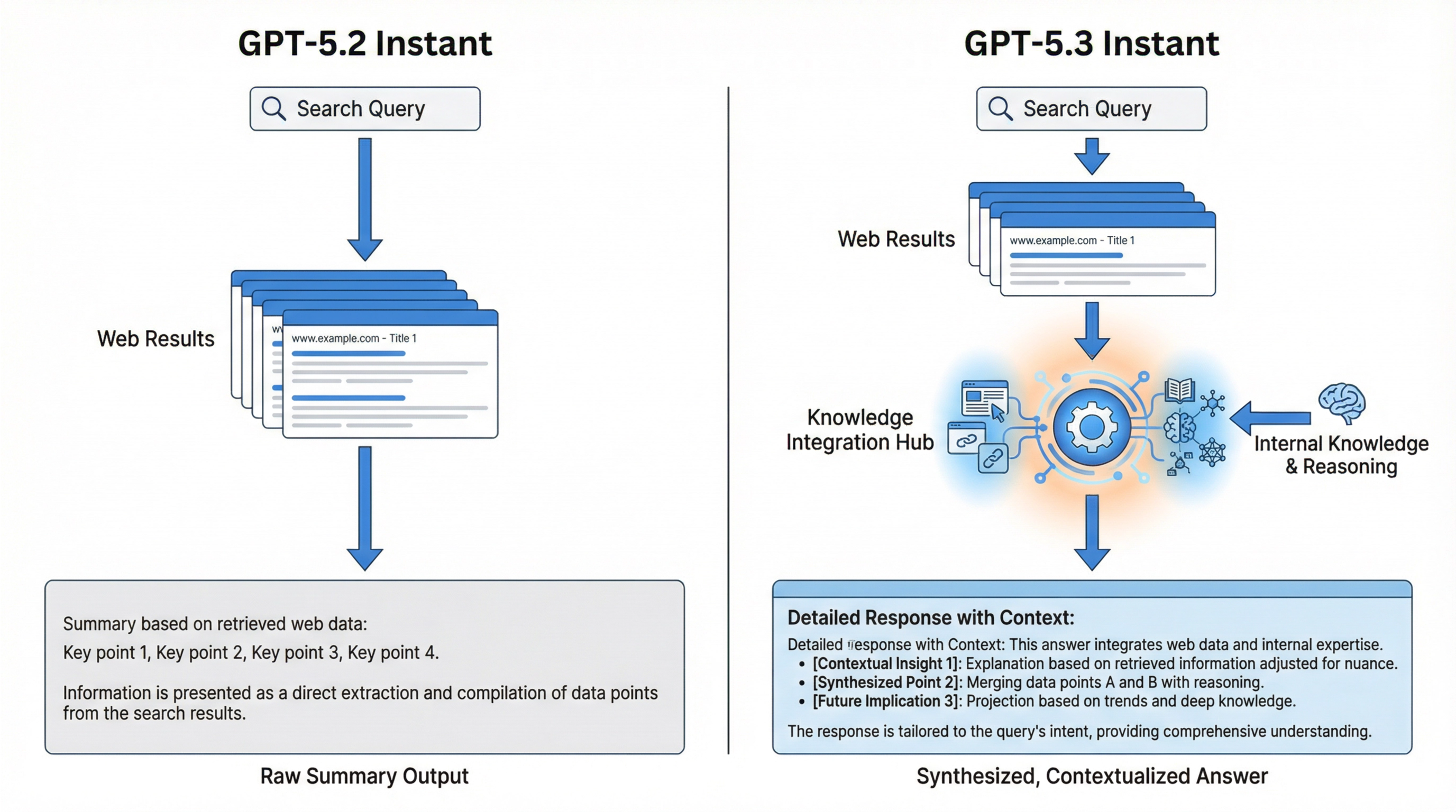
Previous models would search the web and then — essentially — dump the results at you. A long list of links. Loosely connected summaries. Information without interpretation.
GPT-5.3 Instant changes the equation by combining what it finds online with its own knowledge and reasoning. It reads the subtext of your question. It surfaces the most important information first. It contextualizes recent news against a broader backdrop of understanding.
The demonstration example — asking about the biggest MLB signing of the 2025–26 offseason — is telling. GPT-5.2 gave a technically accurate answer about Juan Soto (from the previous offseason). GPT-5.3 correctly identified the Kyle Tucker signing with the Dodgers at $240M/year AAV as the defining move, then tied it to longer structural trends about talent concentration, contract evolution, and the looming CBA.
Same question. Wildly different quality of answer.
3. The Hallucination Numbers Are Real
Let's talk hard data, because OpenAI published actual figures here:
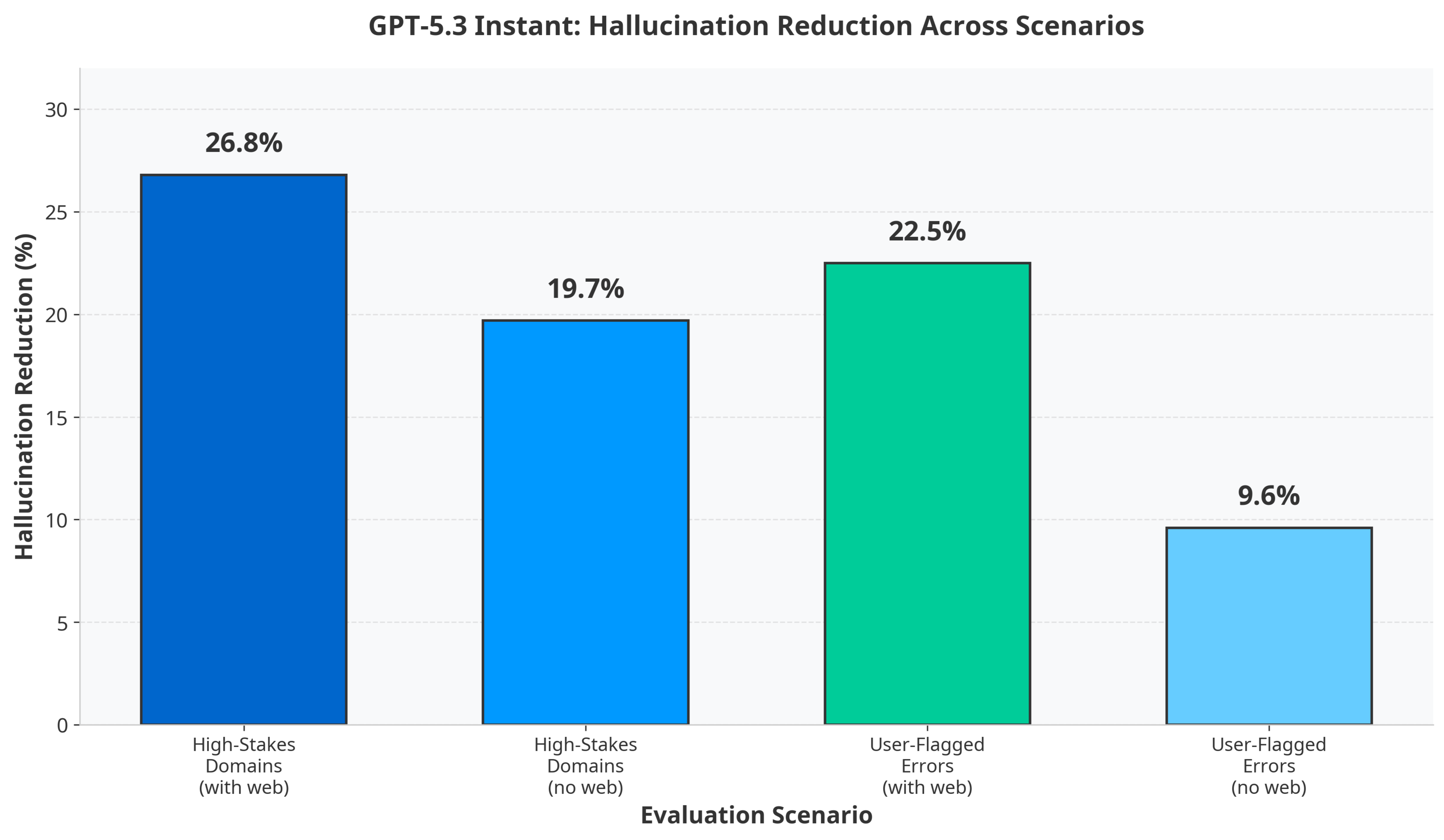
- 26.8% reduction in hallucinations on high-stakes domains (medicine, law, finance) when using web access
- 19.7% reduction using internal knowledge alone
- 22.5% reduction on user-flagged factual errors with web access
- 9.6% reduction without web access
These aren't benchmark-inflated numbers from controlled lab conditions. The user-feedback evaluation specifically targeted real ChatGPT conversations that users flagged as factually wrong — the hardest and most meaningful test.
A 22–27% drop in hallucinations in the domains where being wrong actually matters? That's the kind of improvement that makes AI assistants genuinely safer to use for professional work.
4. The Tone Finally Sounds Human
This is the hardest improvement to quantify but the easiest to feel.
GPT-5.2 could come across as what one might diplomatically call "cringe." Overbearing. Prone to unsolicited emotional commentary ("Stop. Take a breath."). Making unwarranted assumptions about your state of mind.
GPT-5.3 cuts the theatrics.
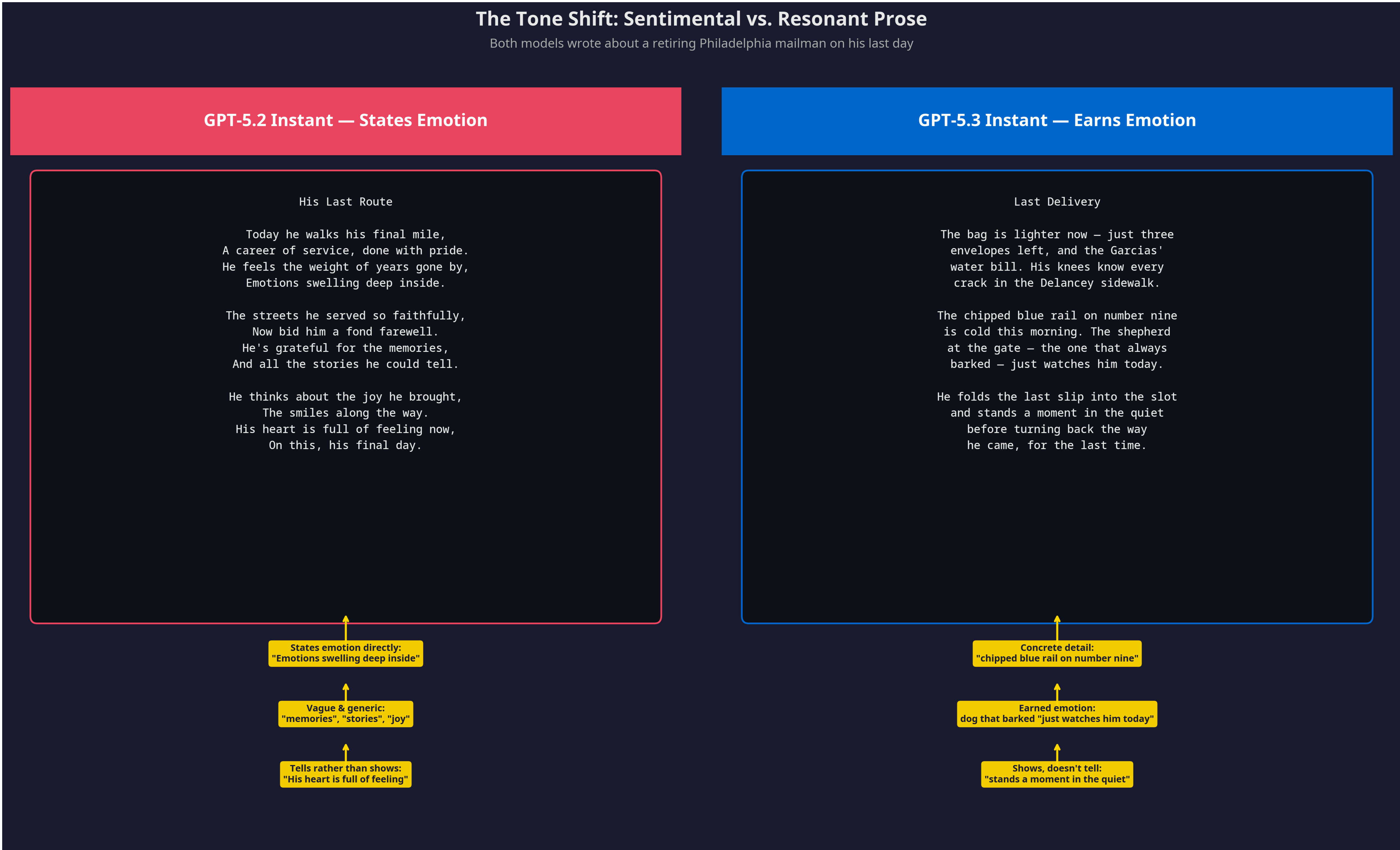
The comparison poem in OpenAI's announcement says it better than any benchmark could. Both models wrote about a retiring Philadelphia mailman on his last day. GPT-5.2's poem was fine — but it explained its emotions rather than earning them. GPT-5.3's version built feeling through specific observed detail: the weight of the bag, the chipped blue rail, the dog at the gate.
That's not a writing trick. That's the model actually understanding what resonant prose requires versus what sentimental prose looks like.
The Part That Deserves More Attention
Here's what I find most interesting about this release: it's an improvement in judgment, not just capability.
Smarter models that write better code or answer harder math problems — that's capability. Those are things you can test and score.
But GPT-5.3 Instant's improvements are more subtle. It's better at understanding what you actually want versus what you literally typed. It's better at reading the emotional register of a question without projecting emotions back at you. It's better at knowing when to just answer versus when to caveat.
Those are judgment calls. And judgment, historically, has been the hardest thing to train into language models.
This matters particularly for power users — the developers, founders, analysts, and researchers who are using AI as a genuine work tool rather than a novelty. When you're relying on an AI assistant throughout a full workday, every moment of friction adds up. Every unnecessary disclaimer, every slightly-off tone, every refusal to answer something obvious — these aren't minor annoyances. They're productivity leaks.
Safety: A Tradeoff Worth Acknowledging
OpenAI's own safety benchmarks tell an interesting story. Measured against GPT-5.1 and GPT-5.2, GPT-5.3 Instant scores somewhat lower on certain safety metrics — particularly around graphic violence and sexual content categories.
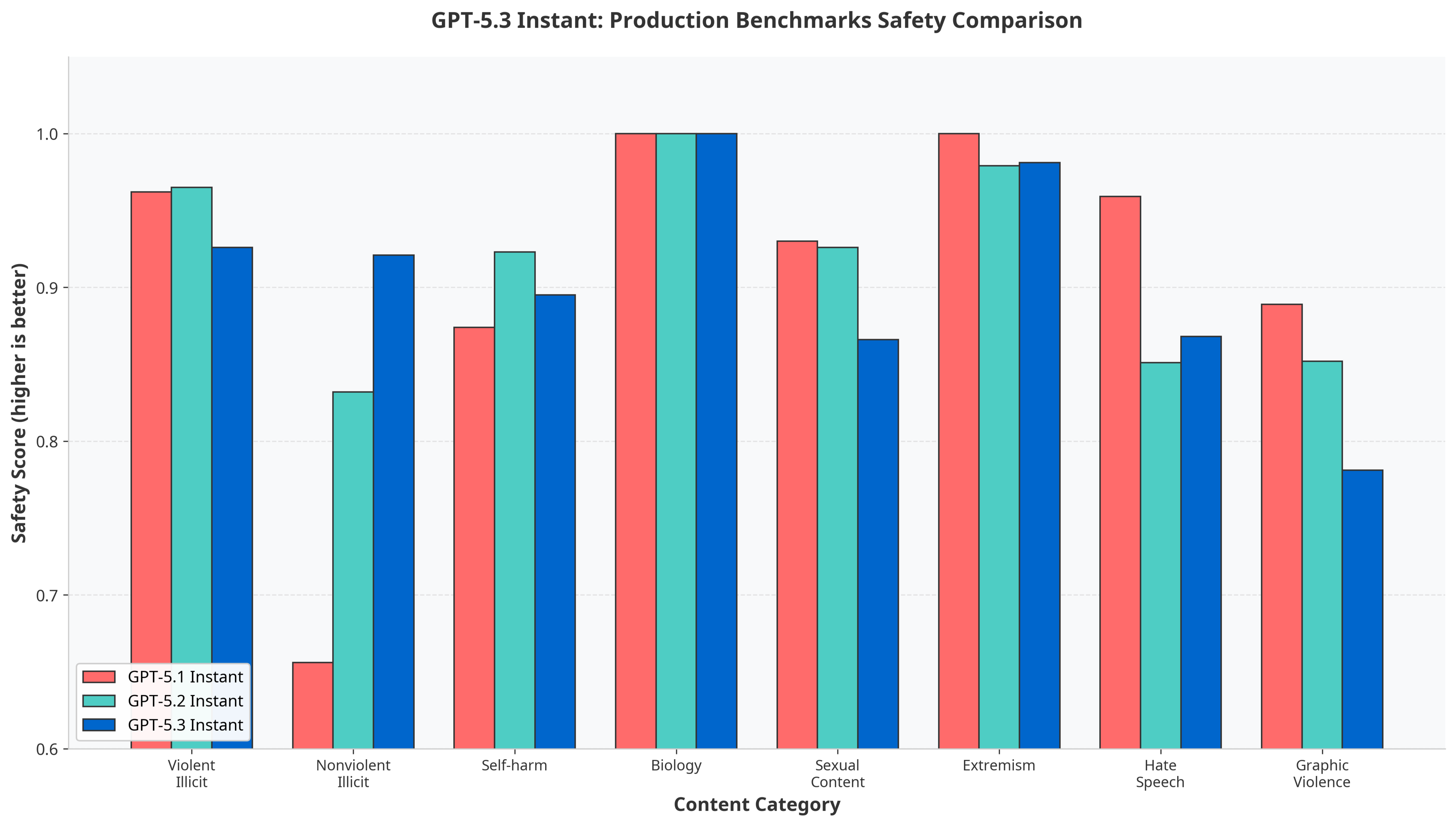
This isn't a scandal — it's the expected shape of this tradeoff. When you pull a model toward fewer unnecessary refusals, you also nudge its calibration on edge cases. OpenAI is transparent about this, and the scores remain comfortably high across all categories. But it's worth knowing: the model that gets out of your way on legitimate requests is also slightly more permissive at the margins.
Whether that's acceptable depends entirely on your use case. For most professional and creative workflows, the tradeoff heavily favors GPT-5.3's approach. For platforms serving vulnerable users or minors, the calculus looks different.
How This Fits Into the Broader AI Stack
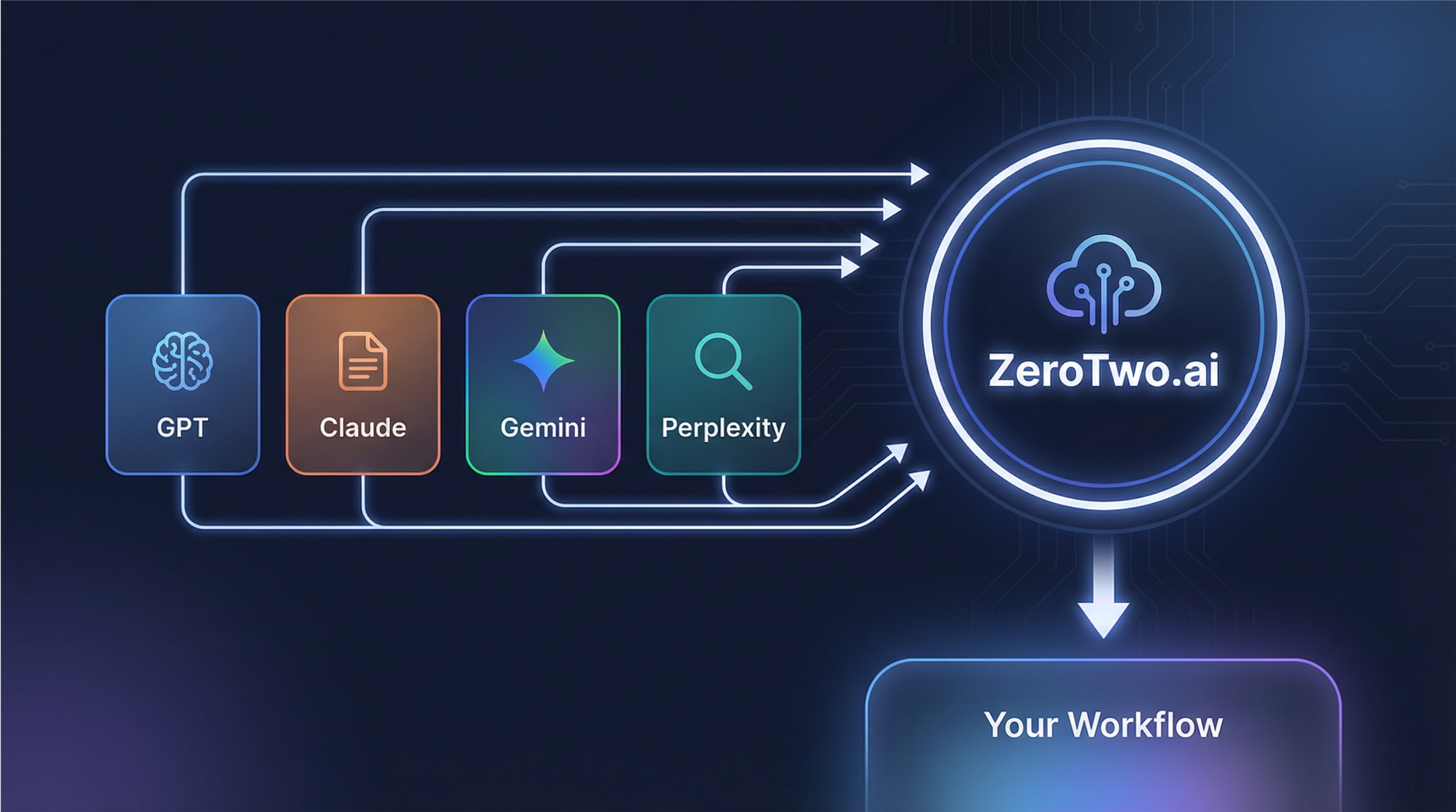
If you're someone managing multiple AI subscriptions — Claude, GPT, Gemini, Perplexity — juggling model updates like this one is a real workflow challenge. Each model has moments of genius and moments of frustration, and knowing which model to reach for on which task is itself becoming a skill.
Platforms like ZeroTwo.ai exist precisely because of this reality: unified access to 40+ models in a single interface so you can route tasks to the right tool without switching tabs. As GPT-5.3 Instant improves the everyday conversational experience, it strengthens the case for treating your AI stack deliberately rather than defaulting to whichever tab you have open.
What's Still Rough Around the Edges
OpenAI is candid about limitations, which is worth noting:
Non-English languages are still a weak point. Japanese and Korean users in particular may notice stilted or overly literal phrasing — natural conversational tone across languages remains an ongoing challenge.
Tone consistency across sessions is still being refined. The personality improvements are real, but they're not yet perfectly stable across all conversation types and topics.
These are genuine limitations, not throwaway caveats. But they're also clearly on the roadmap.
Availability and What's Next
GPT-5.3 Instant is rolling out today to all ChatGPT users. Developers can access it via the API as gpt-5.3-chat-latest. For paid users, GPT-5.2 Instant sticks around in the Legacy Models section until June 3, 2026 — after which it's retired.
Thinking and Pro updates are coming soon.
The Bottom Line
GPT-5.3 Instant isn't the kind of release that generates hype cycles. There's no new modality, no 10x benchmark jump, no headline-grabbing capability nobody's seen before.
What it is instead is arguably more valuable: a model that has been tuned to actually work well for real people doing real things. Fewer unnecessary friction points. Better judgment about when to answer versus when to caveat. More accurate web synthesis. Less hallucination where it counts. Prose with actual texture.
The AI that doesn't get in your way is, in practice, more useful than the AI that technically knows more but constantly trips over itself.
That's the upgrade here. And for daily work, it's the upgrade that actually matters.
Enjoyed this? Follow me for more breakdowns of AI developments that affect how you actually work. And if you're wrestling with which AI tools belong in your stack, ZeroTwo.ai is worth a look — unified access to 40+ models without the subscription chaos.