
The AI model race in 2026 has a new dynamic: the fight isn't just at the top of the benchmark leaderboard anymore. It's in the guts of production systems — the API pipelines, the batch processors, the content moderation queues, the real-time annotation jobs that run millions of times a day.
And that's where Google just made a very loud statement.
On March 3rd, 2026, the Gemini Team quietly dropped Gemini 3.1 Flash-Lite — and if you blinked, you might have missed it. But developers building at scale almost certainly shouldn't.
I've spent time digging into the specs, benchmarks, and early-adopter feedback. Here's my full take.
What Even Is Gemini 3.1 Flash-Lite?
Before we get into the numbers, let's establish what this model is designed to do — because the name tells you most of it.
Flash = fast, optimized for throughput, lower cost than the flagship Pro tier. Lite = the leanest, cheapest variant in the Flash family. 3.1 = the latest generation of the Gemini 3 series, a meaningful generational step up from the 2.x line.
In Google's own words, this is their "fastest and most cost-efficient Gemini 3 series model" — built explicitly for high-volume developer workloads at scale. Translation: this is the model you call a million times a day, not the one you use to reason through a graduate-level physics problem.
But here's where it gets interesting. Thanks to the inclusion of adjustable thinking levels, it can also do that.
The Numbers: Speed, Cost, and Benchmarks
Let me give you the headline stats, because they tell a compelling story.
Speed
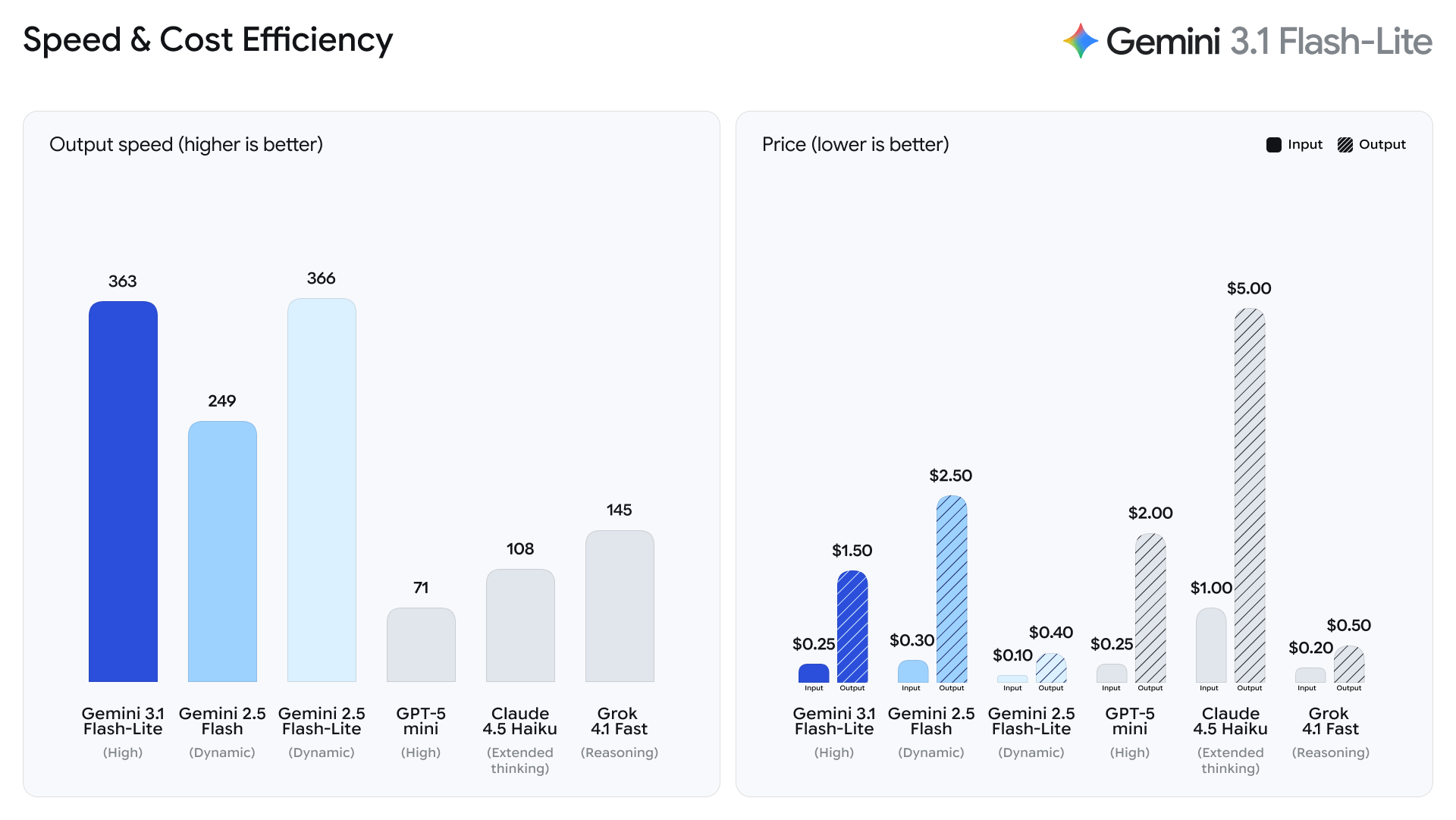
According to independent measurements from Artificial Analysis, Gemini 3.1 Flash-Lite generates output at ~389 tokens per second — ranking #2 out of 132 models in the proprietary/non-reasoning price tier.
For context: the median output speed among comparable models is about 97 tokens per second. This model is running at 4x the median throughput.
Google's own internal comparisons show a 2.5X faster Time to First Answer Token compared to 2.5 Flash, with a 45% increase in output speed according to the Artificial Analysis benchmark.
Cost
- Input: $0.25 per 1M tokens
- Output: $1.50 per 1M tokens
- Blended rate (3:1 ratio): ~$0.56 per 1M tokens
To put this in perspective: you're getting next-generation Gemini 3 series quality at a price point that makes running millions of inferences genuinely economical. This isn't a model you'd use sparingly — it's a model you'd run continuously.
Intelligence
Here's where the story gets more nuanced. On the Artificial Analysis Intelligence Index — a composite benchmark across reasoning, knowledge, math, and coding — Flash-Lite scores 34 out of 100, ranking #19 out of 132 comparable models.
The average among comparable models? 19. So it's placing well above the median for its price tier.
Google's own benchmark numbers are more aggressive:
- 86.9% on GPQA Diamond (scientific reasoning)
- 76.8% on MMMU Pro (visual/multimodal understanding)
- Elo score of 1432 on the Arena.ai Leaderboard
It even outperforms larger Gemini models from prior generations — including 2.5 Flash — on several of these benchmarks. That last point is worth sitting with: a cheaper, faster Lite model is beating its own more expensive predecessors.
The Benchmark Table: How Does It Stack Up Against the Competition?
Google released a direct comparison table against the key models in its competitive tier: GPT-5 mini, Claude 4.5 Haiku, Grok 4.1 Fast, and Gemini 2.5 Flash-Lite.
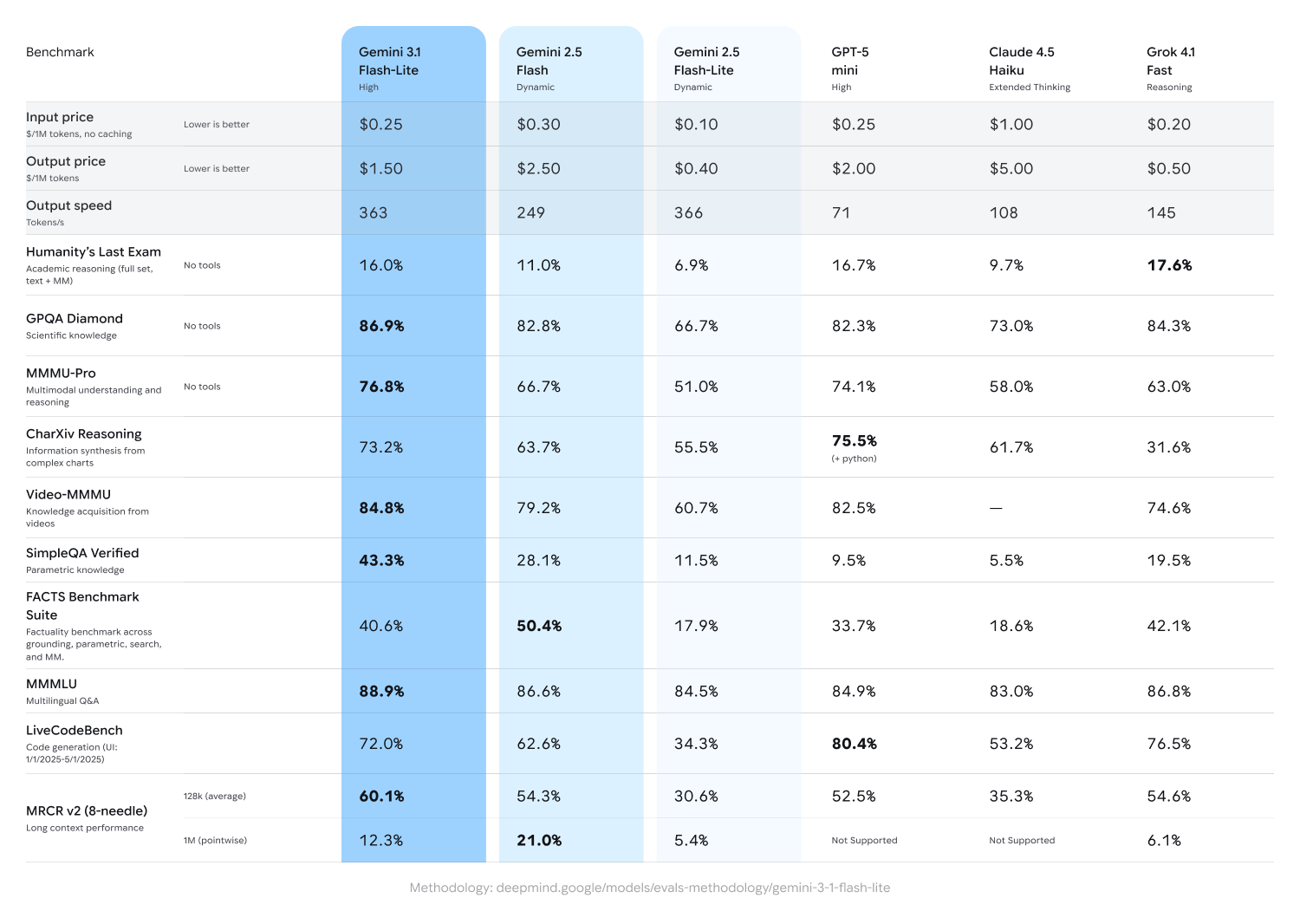
The verdict from Google's own data: Flash-Lite is competitive or better on the major reasoning and multimodal benchmarks while maintaining pricing and speed that puts it in a class of its own on throughput.
One important caveat: output pricing at $1.50/M tokens sits somewhat above the median of $0.90/M for comparable models. For extremely output-heavy workloads, this is worth factoring in. But for tasks where inputs dominate (summarization, classification, moderation), the $0.25/M input cost is extremely attractive.
The Killer Feature Nobody's Talking About: Thinking Levels
Most coverage of this model is stopping at the speed and price numbers. But the feature that deserves more attention is the inclusion of thinking levels — adjustable reasoning depth — built in as standard.
In AI Studio and Vertex AI, developers can configure how much the model "thinks" before answering. This isn't just a toggle between fast and smart — it's a spectrum.
Why does this matter?
Because it means one model can serve multiple roles in your stack.
- Running bulk content moderation at max throughput? Set thinking to minimum.
- Generating a complex multi-step UI from a prompt? Dial it up.
- Answering high-frequency customer support queries? Middle ground.
This adaptability is actually quite rare in the "lite" tier of models. Most cheap-fast models are cheap-fast everywhere and make no claims on complex reasoning. Flash-Lite is positioned differently — and early adopters seem to agree it follows through.
What Real Users Are Saying
Google surfaced early feedback from developers already building with 3.1 Flash-Lite in production. The testimonials skew technical and specific:
Kolby Nottingham at Latitude praised the model's instruction-following capabilities and speed — noting that it can handle complex inputs with the precision of a larger-tier model.
Andrew Carr at Cartwheel highlighted the speed and multimodal labeling capabilities, which is notable for a model in this price tier where vision quality often drops significantly.
Bianca Rangecroft at Whering called out consistent item tagging and data labeling as a strength — a use case that demands both speed and output consistency across thousands of items.
Kaan Ortabas at HubX shared more specific performance metrics around cost efficiency — noting that the economics made sense at their scale in a way prior models hadn't.
The pattern across these testimonials: high-volume, repetitive, but not trivial tasks. Tagging. Labeling. Structured data generation. Instruction-following at scale. These aren't toy demos — they're the actual unsexy workhorses of production AI systems.
Use Cases Where This Model Shines
Based on the specs and early feedback, here's where I'd reach for 3.1 Flash-Lite:
Content Moderation at Scale The throughput and pricing math makes this a legitimate option for running moderation on user-generated content pipelines. At 389 tokens/sec with input pricing of $0.25/M, you can process enormous volumes cheaply.
Data Labeling and Classification Multimodal support (text, image, speech, video) combined with strong instruction following makes this a compelling tool for annotation workflows that traditionally required expensive human-in-the-loop processes or heavier models.
Real-Time UI Generation Google's own demos show Flash-Lite filling an e-commerce wireframe with hundreds of products and generating dynamic weather dashboards with live data — in real time. If you're building generative interfaces, this is a model worth experimenting with.
High-Volume Translation The speed profile is essentially built for this. Translation at 389 tokens/second is meaningfully different from translation at 97 tokens/second when you're processing millions of strings.
SaaS Automation Agents With 1M token context window and adjustable thinking, Flash-Lite can handle multi-step agentic tasks for business workflows — Google's own demo shows a SaaS agent executing complex multi-step tasks in a single run.
Honest Limitations
No model review worth reading glosses over the weaknesses.
Output token pricing is above median. At $1.50/M output tokens versus the ~$0.90/M median for this tier, output-heavy tasks will cost more than alternatives. If you're generating long-form content at scale, this matters.
Latency to first token is higher than expected. Artificial Analysis measured a time-to-first-token (TTFT) of 5.18 seconds, which is significantly above the median of 1.81s for comparable reasoning models. Once it starts streaming it's blazing fast — but if your use case is sensitive to initial latency (real-time chat interfaces, for example), this is a real consideration.
Proprietary and closed. No open weights, undisclosed parameter count. If you need an auditable, on-prem, or fully open-source stack, this isn't your model.
Output-only in text. Despite accepting multimodal inputs (text, image, speech, video), outputs are text-only. No image or audio generation.
Verbose by default. The model generated 53M tokens to complete the Intelligence Index evaluations — versus a median of 20M for comparable models. Verbosity can be a feature (thoroughness) or a cost center, depending on your use case.
How ZeroTwo.ai Users Are Thinking About This
If you're managing AI infrastructure across multiple providers and use cases — which is exactly what the ZeroTwo.ai platform is built for — a model like Flash-Lite slots into your stack in a very specific way.
It's not a replacement for a frontier reasoning model when depth matters. But for the long tail of production tasks that make up the majority of API calls — classification, moderation, extraction, labeling, rapid generation — it competes hard on the price-performance curve.
The thinking levels feature is particularly relevant for unified AI platforms: the ability to dynamically adjust reasoning depth means you can route different task types to the same model with different configs, rather than maintaining separate pipelines for "fast cheap tasks" and "complex tasks."
The Broader Context: Why This Launch Matters
The release of Gemini 3.1 Flash-Lite isn't happening in a vacuum. It's part of a broader pattern: the frontier AI labs are pushing hard into the production/developer tier, not just the benchmark leaderboard.
The real competition in 2026 isn't Gemini vs. GPT-5 on reasoning evals. It's Gemini Flash-Lite vs. GPT-5 mini vs. Claude 4.5 Haiku — the workhorses of the AI economy. These are the models that will actually process the majority of real-world tokens over the next year.
What makes Flash-Lite notable is that it's the first model in this tier that's clearly bringing Gemini 3 series quality — including native reasoning — to the low-cost segment. Prior lite-tier models were often architecturally simplified versions of their bigger siblings. The claim here is that Flash-Lite is just Gemini 3.1, running faster and cheaper.
If that claim holds up under extended real-world use, this is a meaningful moment.
Availability and Getting Started
Gemini 3.1 Flash-Lite is currently available in preview via:
- Google AI Studio → aistudio.google.com (model:
gemini-3.1-flash-lite-preview) - Vertex AI (enterprise) → via the Vertex AI console
It's accessible through the Gemini API with standard authentication. The preview period means some things may change before GA — but it's live and usable today.
Final Verdict
Gemini 3.1 Flash-Lite is the most credible challenge to the status quo in the cheap-fast AI tier in 2026.
The combination of Gemini 3 series quality, genuine reasoning capability through adjustable thinking levels, blistering throughput (nearly 4x the category median), and competitive input pricing creates a model that's hard to dismiss — even if the output pricing and initial latency numbers leave some room for improvement.
For developers running high-volume pipelines who've been defaulting to flash-tier models from other providers out of habit, this is worth a serious benchmarking run against your actual workloads.
The model that wins the production AI market won't be the smartest model in the room. It'll be the one that's smart enough, fast enough, and cheap enough to run everywhere. Gemini 3.1 Flash-Lite just put in a serious application for that title.
Reed Vogt is the founder of ZeroTwo.ai, a unified AI platform giving teams access to 40+ models — including the full Gemini family — with a single integration hub. If you're evaluating AI models for production use, ZeroTwo makes it easy to benchmark, compare, and deploy across providers.